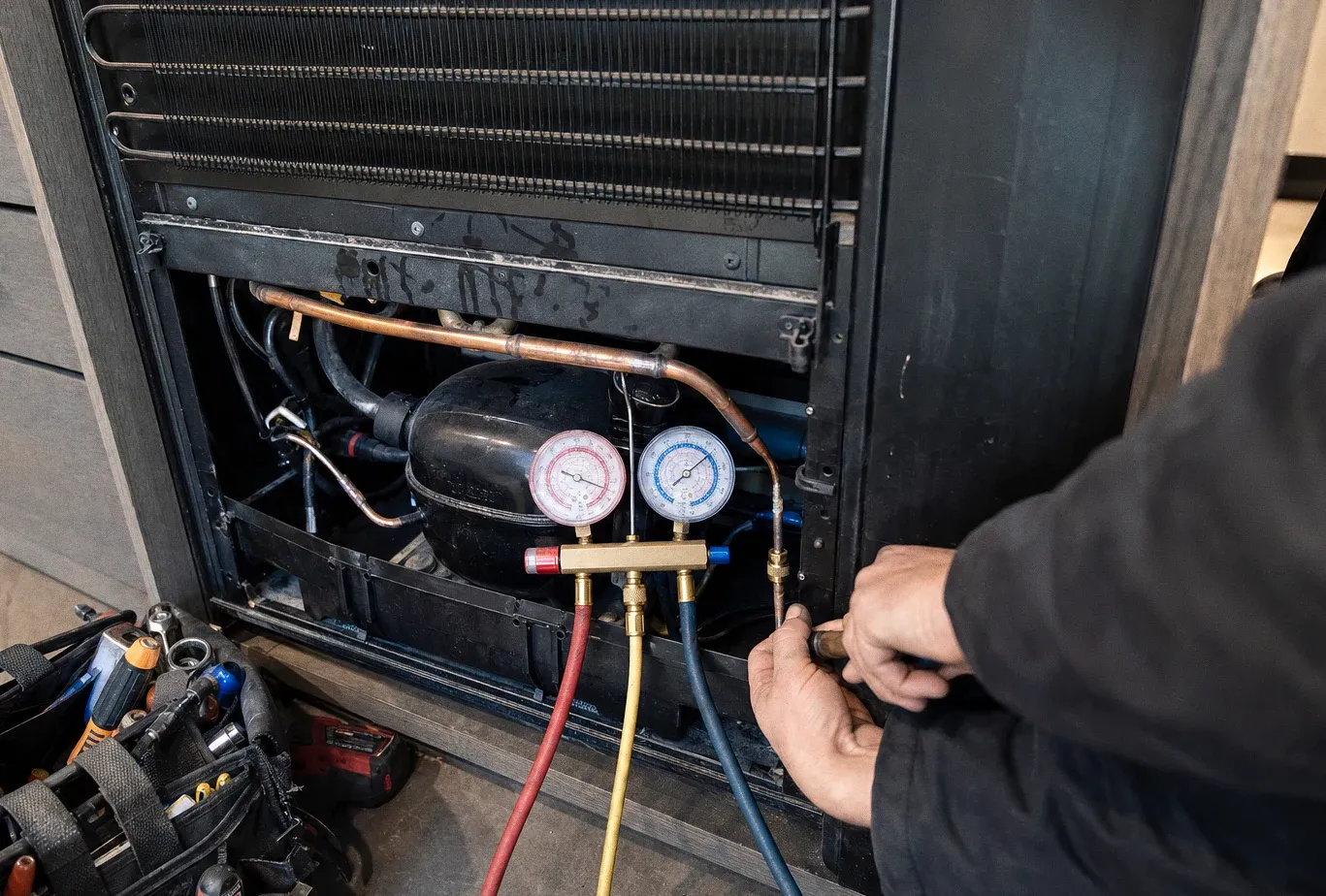
Sub-Zero Ice Maker Repair
Sub-Zero Ice Maker Making Cloudy, Hollow Cubes in Boston: Read the Shape
Cloudy, hollow, undersized and fused cubes are four separate faults, not one: shape points at fill volume, a white core at dissolved air and minerals, a slab at harvest timing. Read the cube first, then work back through the supply, the filter and the release side of the cycle.

The ice keeps arriving, but it is wrong. Cubes come off the mould dished in the middle, white and opaque rather than clear, or welded into a lump that has to be broken up with the scoop. Nothing on the control panel is complaining, so most households top up from a bag and leave it another month. That is a waste of good evidence, because what is sitting in the bin amounts to a fairly precise fault report.
Read the cube before you touch the appliance
Pull out a handful and look at four things: shape, clarity, size, and whether the cubes are loose or stuck to one another. A dished or hollow cube means less water reached the mould than the cycle expected. A white core means something completely different. A solid slab is a third fault, and cubes that are simply small — clear, separate, just undersized — are a fourth.
Take them in turn. Hollowing points at fill volume, or at a freeze that ran its course before the mould was full: water solidifies from the outer wall inwards, and if there was never enough of it, the middle never closes. Cloudiness is not dirt. Dissolved air and dissolved minerals get pushed ahead of the advancing ice and end up concentrated in whatever freezes last, which is why the white sits in the core and not on the surface. Cubes that release cleanly and then set into a block once they are in the bin are describing timing and turnover, not cooling capacity. Cubes that are undersized but otherwise perfect are usually a water story rather than a mechanical one.
Where the appliance lives changes which of these turns up. In a Beacon Hill garden level, or a South End bowfront where the column is boxed into a joinery run against the party wall, the supply takes the long way round and is handled by every trade that works in the room. In Medford, where the kitchen is often a rear addition bolted onto a much older house, that same line may have been lengthened twice and reduced once along the way. Decide which of the four faults you actually have before anyone starts pulling panels.
Everything upstream of the appliance
Follow the water backwards before suspecting anything inside the cabinet. A hollow cube is a shortage symptom, and shortages usually live in the plumbing rather than in the machine: a stop only part-way open, a valve closed during other work and never fully reopened, an old saddle tap silting up, or tubing pinched where the unit was pushed home.
Start with the shut-off. In these houses it is under the sink or down in the cellar between the joists, and it gets closed every time a plumber or a cabinetmaker needs the room. Part-way open behaves worse than shut, because the appliance still fills — just not enough, which is precisely the cube you are holding. Saddle valves are the other perennial: fitted quickly, piercing the pipe through a small tap, and slow to give up their bore to sediment.
Then look at whatever length of line you can actually see. Copper bent to get an appliance back into a tight alcove keeps that kink for good. Plastic tubing crushed against a cabinet rail does the same. In a North End walk-up, where everything came up three flights and was shoved into place by two people with nowhere to stand, this is close to routine. Less pressure at the inlet means less water in the seconds the cycle allows for filling, and less water in the mould gives you a dished cube every time.
The filter, and the interval that lapsed
A saturated cartridge restricts flow long before it changes flavour, so a household perfectly happy with its drinking water can be running a filter that is quietly starving the fill. Taste is the last symptom to show up, not the first, and by the time it arrives the ice has been deteriorating for a while.
Two traps sit alongside that. Aftermarket cartridges differ in how freely they pass water, and one that filters adequately while flowing poorly produces exactly the same small, dished cube as a clogged original — the flow rate matters as much as the filtration does. Second, running on bypass is a useful test but a weak proof. If the cubes improve without the cartridge in circuit, it was part of the problem. If they do not, you have eliminated one candidate and learned nothing else.
On timing: take the interval from the use and care literature for your own series rather than a number lifted from a search result, because it varies between models and a household drawing a lot of water reaches it sooner than the calendar suggests. If nobody can remember the last change, the interval is academic.
Harvest: making ice and letting go of it
Harvest is the release half of the cycle. The mould fills, the water freezes, and then the machine has to persuade finished cubes to let go and drop into the bin before it can begin again. Making ice and releasing it are separate jobs, and an appliance can be competent at one and poor at the other.
Slabs generally belong to this half. Cubes released properly and then left sitting for days will bond to one another on their own — come back from a fortnight away and you will find a block, with nothing wrong anywhere. If the bin turns over regularly and the ice still fuses, the timing is off: a batch is landing on one that has not settled, or the cycle is repeating sooner than it should.
What is observable without tools: whether the ejector sweeps the mould clear, whether the sensing arm swings freely or is being propped up by a stray cube, and whether the bin has been pushed home far enough for that arm to sit where it belongs. That is the end of the list. Past it, panels come off and live parts are exposed, which is where this becomes a job for Ice Maker Repair rather than another guess.
What is worth calling about
Three things end the investigation immediately: water on the floor, a joint that is wet to the touch, or a compartment that will not hold its temperature. Poor ice is an irritation. Those three are damage in progress, usually in a room sitting directly above somebody else’s ceiling.
Everything else is a question of measurement. A visit establishes what a homeowner has no way to see — how much water genuinely enters the mould on a fill, what pressure the inlet is being offered, how long a cycle takes against how long it ought to, and whether the control is even calling for water. Those four readings separate a plumbing fault from a valve fault from a control fault in a single trip, and they are the reason buying parts on a hunch is the expensive route.
Sub-Zero Repair Boston covers Beacon Hill, the South End and Medford, and the North End stairs and all. Both routes are on this page already: call the number, or take a slot through the booking link. Whichever you use, have the model number to hand and be ready to describe the shape of the cube.
Still asked on the phone
Why is my ice cloudy when the tap water is clear?
Clarity in a glass and clarity in a cube are different things. Tap water carries dissolved air and dissolved minerals you cannot see. As a cube freezes from its outer wall inwards, both are pushed ahead of the advancing ice and concentrate in whatever solidifies last, which shows up as a white core. Perfectly clear water at the tap and cloudy ice in the bin are entirely consistent with each other.
How often should the water filter be changed?
Use the interval printed in the use and care guide for your own series rather than a general figure, because it differs by model and by how much water the household draws. The practical rule is that a cartridge restricts flow before it changes taste, so waiting for the water to taste different means waiting far too long. If nobody remembers the last change, change it.
The cubes have started fusing into a block — what changed?
Usually one of two things. Either the bin is not being emptied as often as it once was, and ice left undisturbed will bond to itself with no fault involved; or the release side of the cycle is running early, dropping a fresh batch onto one that has not settled. Ask first whether household demand changed. If it did not, the timing is what needs looking at.